
Epochen Englisch
1125-1156 Dealers
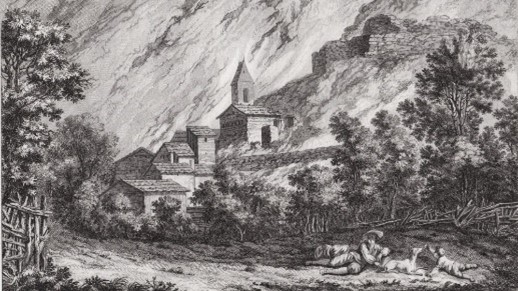
In the 12th century, the Simplon Pass gained in importance as a transit route for goods between the emerging northern Italian cities and the large goods fairs in the Champagne region of north-eastern France. That is why the Counts of Savoy and the Bishops of Sion expanded the road through the Rhone Valley to facilitate the movement of goods over the Simplon Pass. Fabrics, furs, leather, spices, weapons and armour passed through the Valais in several stages. These stage locations were called “Susten”. At the same time, a Suste was also set up in Niedergesteln, and the farmers of Niedergesteln were able to earn a little extra money as mule drivers and small traders. In this way, trade and transport across the Simplon also contributed to the maintenance of rural families in Niedergesteln. With the Suste, which brought modest prosperity to the village, Niedergesteln gradually gained in political importance.
1157-1375 Serfs
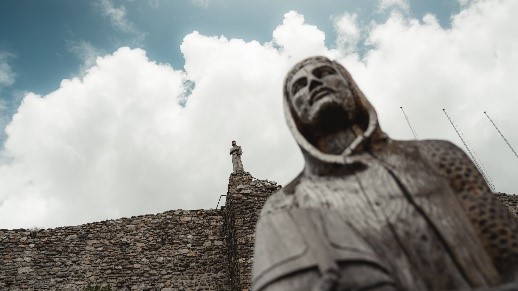
For around 225 years, the farming families of Niedergesteln were serfs of the Barons of Turn. As serfs, they had to perform unpaid labour for their landlords, pay rent and tithes, could only marry with the permission of their landlords, were not allowed to leave the farm, were subject to the jurisdiction of their landlords and serfdom was inherited from father to son. Although it was possible to buy your way out of serfdom, the exorbitant sums involved made this an unrealistic prospect. In return, the serfs came under the protection of the barons of Turn.
1376-1790 Subjects
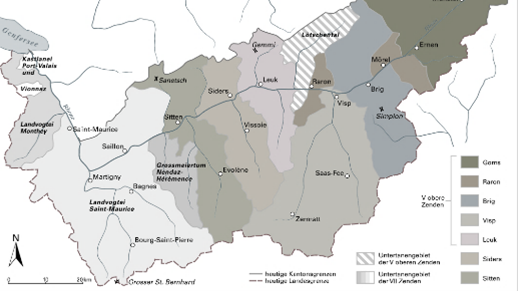
In 1375, the five upper Zenden (districts of Valais) occupied Gesteln Castle. The feudal lords of Turn were expelled and Niedergesteln, together with Lötschental, Steg, Hohtenn and Eischoll, was assigned to the district of Raron as a subject area until 1790. As a subject area, the inhabitants of Niedergesteln were not allowed to participate in the administration of the country, could not occupy any state offices and were excluded from the state benefits, the income from the bailiwicks and the war pensions. They received no benefits, but had to contribute a third of the costs of the Zenden, for example, the costs of military service.
Ne tirant aucun profit d’un quelconque bénéfice, ils devaient en outre participer aux charges du Dizain à hauteur d’un tiers : par exemple, les frais du service militaire.
1791-1814 Republicans
In 1790, Niedergesteln finally bought itself out of the subservience of the upper Zenden. The French invasion of 1798 was probably the most eventful 15 years in the contemporary history of Niedergesteln. Until Napoleon’s capitulation in 1813, the inhabitants of Niedergesteln were republicans of the Helvetic Republic (1798-1802), republicans of the independent Republic of Valais (1802-1810), were then French citizens in the Département du Simplon (1810–1813), and after France’s defeat in 1813, they were under the administration of Austria and the allied forces (1813–1815).
1815-2025 Confederates
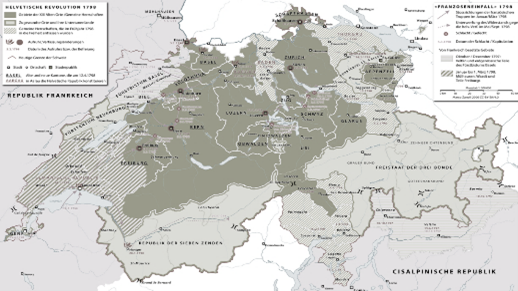
With the act of union of 4 August 1815, Valais became the twentieth canton of the Swiss Confederation. In the interests of internal stability, the canton of Valais was divided into 13 districts with equal rights (known today as ‘Bezirke’). Thus, the inhabitants of Niedergesteln are henceforth citizens of the municipality of Raron (since 1987 the district of Western Raron) and are Swiss.